A Christian Buddha


The Story of Barlaam and Josaphat

There is a scene in the Merchant of Venice in which the suitors of Portia, a spirited young heiress, are shown three caskets, one of gold, one of silver, and one of lead. One of them contains Portia’s portrait, and according to her father’s will the suitor who chooses the right casket, the one containing the portrait, will be able to marry Portia. The Prince of Morocco chooses the gold casket, but on opening it he finds only a skeleton and some verses beginning All that glitters is not gold; Often have you heard that told.

Similarly the Prince of Aragon, on being shown the caskets, chooses the silver one and to his chagrin finds the portrait of a ‘blinking idiot’ and some sardonic verses. The third suitor is Bassanio, a young Venetian with whom Portia herself is secretly in love. He chooses the lead casket, where he finds Portia’s portrait and verses inviting him to claim the lady ‘with a loving kiss’. Few of those who have seen the play will have known that Shakespeare took the theme of the Three Caskets from the romance of Barlaam and Josaphat, a Christianized version of episodes from the life of the Buddha, which he found in The Golden Legend (1483), Caxton’s version of a French translation of the Legenda Aurea, a work compiled in Latin by the thirteenthcentury Dominican friar Jacobus de Voragine who became Archbishop of Geneva.

The story of the monk Barlaam and prince Josaphat underwent many changes before eventually passing from Voragine to Caxton and from Caxton to Shakespeare, but in Caxton’s English version, still very readable, incidents which are parts of the Buddha’s biography as handed down in Buddhist tradition can nevertheless still be discerned. The story begins in a legendary India, which is represented as being ‘full of Christians and of monks’. At this time there arose a powerful king named Avennir who persecuted the Christians, and especially the monks. Nonetheless, a friend of the king who was also his chief minister was inspired to leave the palace and become a monk. When the king heard of this he was beside himself with rage and ordered a search to be made for the monk, who was eventually found and brought before the king. On seeing his former minister ‘in a vile coat andmuch lean for hunger’ Avennir called him fool and madman and wanted to know why he had changed his honour into disgrace and made himself a mockery. If he was willing to listen to reason, the monk replied, then he should put from him his enemies. The king naturally wanted to know who his enemies were. They were anger and greed, the monk explained, for they obscured and hindered the mind, so that the truth might not be seen. ‘The fools despise the things that be’, the monk continued, ‘like as they were not, and he that hath not the taste of the things that be, he shall not use the sweetness of them, and may not learn the truth of them that be not.’

I was greatly struck by these words. Behind them, beneath all the layers of adaptation and modification, I could see an important teaching of the Buddha that must have come from one of the traditional Indian biographies. The spiritually immature despise the real because they see it as unreal; and he that has no experience of the real will not benefit from the happiness it brings, nor, since he sees the real as unreal, will he see the unreal as unreal. This is reminiscent of a verse in one of the best known Buddhist scriptures: ‘Those who, having known the real (sara) as the real, and the unreal (asara) as the unreal, they, moving in the sphere of right thought,will attain the real’ (Dhammapada 12). Whoeverwas originally responsible for this version of the story of Barlaam and Josaphat must have felt that the monk’s teaching to the king was not particularly Christian, as indeed it is not, for he credits the monk with having gone on to ‘show many things of mystery of the incarnation’, which is obviously out of place and very likely was added at some stage. Be that as it may, Avennir was not impressed by the monk’s teaching. Had he not promised to put away anger, he tells him, he would have burned him alive. Let him go now, lest he should do him some harm.

Meanwhile, it so happened that a son was born to the king, who hitherto had been childless. The boy was called Josaphat, which is not really a proper name but the form assumed by the Sanskrit word ‘bodhisattva’ after it had been transcribed from the alphabet of one language into that of another, and from that into yet another, thus becoming a little further removed from its original spelling and pronunciation each time. In the traditional biographies the term ‘Bodhisattva’ refers to the Buddha in the pre-Enlightenment phase of his career, the word meaning ‘Enlightenment-being’ or ‘one bent on Enlightenment’. On the birth of Josaphat ‘the king assembled a right great company of people for to sacrifice to his gods for the nativity of his son, and also assembled fifty-five astronomers, of whom he enquired what should befall of his son.’

In the Abhiniëkramaœa Sûtra or ‘Sûtra of the Great Renunciation’, one of the canonical biographies of the Buddha, the astrologers assembled by King Suddhodana, the Bodhisattva’s father, predicts that his son will become either a universal monarch or a Buddha, an Enlightened One. A sage who has arrived from the Himalayas, however, predicts that he will definitely become a Buddha. King Avennir’s astronomers tell him that Josaphat will be ‘great in power and in riches’; but one of them, wiser than the others, predicts that the child will be a Christian, a member of the religion that the king persecutes. Disturbed by the prediction, Avennir took measures to ensure that Josaphat does not hear about Jesus Christ. They are the same measures taken by Suddhodana, in the traditional biographies of the Buddha, to ensure that Siddhartha does not learn about the realities of human existence. In Caxton’s words:

And when the king heard that, he doubted much, and did do make without the city a right noble palace, and therein set he his son for to dwell and abide, and set there right fair younglings, and commanded them that they should not speak to him of death, ne of old age, ne of sickness, ne of poverty, ne of no thing that may give him cause of heaviness, but say to him all things that be joyous, so that his mind may be esprised with gladness, and that he think on nothing to come. And anon as any of his servants were sick the king commanded for to take them away, and set another, whole, in his stead, and commanded that no mention should be made to him of Jesus Christ.

Except for the reference to Jesus, the Buddhist will find himself on familiar ground here. He will also know what follows. But at this point the story of Barlaam and Josaphat, as translated by Caxton, is interrupted by a tale of palace intrigue, in which King Avennir tries to trick his chief noble into admitting that he was a Christian by telling him that he has decided to become a monk, and in which the noble tricks the king, and saves his own life, by becoming a monk in order, as he says, to accompany the king into the desert and serve him there. The story is then resumed, and the Buddhist again finds himself on familiar ground. When Josaphat grew up he wondered why his father had so enclosed him, and became greatly depressed that he could not go out. On hearing this the king made arrangements for ‘horses and joyful fellowship’ to accompany him, but in such a way that he should see no distressing sight.

And on a time thus as the king’s son went, he met a mesel (leper) and a blind man, and when he saw them he was abashed, and enquired what them ailed, and his servants said: These be passions (sufferings) that come to men. And he demanded if those passions come to all men, and they said: Nay. Then said he: Be they known which men shall suffer these passions without definition? And they answered: Who is he that may know the adventures of men? And he began to be much anguishous for the incustomable thing thereof. And another time he found a man much aged which had his cheer (face) frounced (wrinkled), his teeth fallen, and was all crooked for age.
Whereof he was abashed, and he desired to know the miracle of this vision. And when he knew that this was because he had lived many years, then he demanded what should be the end, and they said: Death; and he said: Is then death the end of all men or of some? And they said for certain that all men must die. And when he knew that all should die, he demanded them in how many years that should happen, and they said: In old age or four score years or a hundred, and after that age the death followeth. And this young man remembered oft in his heart these things, and was in great discomfort, but he showed him much glad tofore his father, and he desired much to be informed and taught in these things.

Josaphat has now seen the first two, and heard about the third, of the Four Sights that are described at length, and with a wealth of detail, in the traditional biographies of the Buddha; but he has yet to see the fourth sight, that of a monk. In the story of Barlaam and Josaphat it naturally is a Christian monk that he meets. The monk’s name is Barlaam. The derivation of the name is uncertain: it may be a corrupt form of the Sanskrit word bhagavan, meaning ‘lord’. Barlaam is described as ‘a monk of perfect life and good opinion that dwelled in the desert of the land of Senaar’. Coming to know about Josaphat by divine inspiration, he disguised himself as a merchant and gained access to him by telling ‘the greatest governor of the king’s son’ that he had a miraculous precious stone to sell and wished to offer it to the prince. The governor wanted to see the precious stone, but on hearing that it could be safely seen only by one who was wholly chaste he changed his mind and brought him to Josaphat, who received him honourably.

Barlaam told him he did well in taking no heed of his ‘littleness that appeareth withoutforth’. He was like the king whose barons were displeased with him for getting down from his chariot and humbly saluting to poor men, thus compromising his royal dignity. In order to teach them a lesson the king ordered four chests to be made. Two of the chests he covered with gold and jewels and filled and with dead men’s bones and filth. The other two he covered with pitch and filled with precious jewels and rich gems. Here we obviously have the originals of the Three Caskets in The Merchant of Venice, where despite his more romantic handling of the theme Shakespeare draws much the same moral as Barlaam, who continues:

And after this the king do call his great barons…and did do set these four chests tofore them, and demanded of them which were most precious, and they said that the two that were gilt were most of value. Then the king commanded that they should be opened, and anon a great stench issued out of them. And the king said: They are like them that be clothed with precious vestments and be full withinforth of ordure and of sin. And after he made open the other and there issued a marvellous sweet odour. And after, the king said: These be semblable to the poor men that I met and honoured, for though they be clad in foul vestments, yet shine they withinforth with good odour of good virtues, and ye take none heed but to that withoutforth, and consider not what is within.

Having related this apologue, Barlaam preached Josaphat a long sermon about the creation of the world, about the day of judgement, and about the reward of good and evil. This he followed up with a series of apologues, some of them quite amusing, on the foolishness of idol worship, the fallaciousness of worldly pleasure, the difference between true and false friendship, and the inevitability of death. Several of the apologues have, to me, a familiar, almost Buddhistic ring to them, especially the one on true and false friendship. There was a man who had three friends. He loved the first friend as much as himself, the second less than himself, the third little or naught. It so happened that this man was in danger of his life, and was summoned before the king. He ran for help to his first friend, reminding him how much he had always loved him. But the friend refused to help, saying he had to spend the day with other friends, and in any case he did not know him. The man went sadly to his second friend, who excused himself from accompanying him to the king, saying he had many responsibilities; but he would accompany him as far as the palace gate. At last the man went to his third friend. ‘I have no reason to speak to thee,’ he admitted, ‘ne I have not loved thee as I ought, but I am in tribulation and without friends, and pray thee that thou help me.’

The third friend readily agreed to the man’s request, saying, ‘I confess to be thy dear friend and have not forgotten the little benefit thou hast done to me, and I shall go right gladly with thee tofore the king, for to see what shall be demanded of thee, and I shall pray the king for thee.’ The first friend, Barlaam explained, was possession of riches, for the sake of which man puts himself in many dangers, and of which he can take with him, when death comes, only the winding sheet in which he will be buried. The second friend was his sons, his wife, and his kin, who can go with him only as far as his grave, after which they will return home and get on with their own lives. The third friend was faith, hope, and charity, and other good works we have done, which when we leave our bodies may go before us and pray for us to God, and may deliver us from our enemies the devils.

The first time I read this apologue, in Caxton’s English version, it at once put me in mind of the old morality play of Everyman which I saw at a London theatre during the War. This ballet moved me more deeply than had the play on which it was based, with which I was already familiar. On the drop curtain Blake’s ‘Ancient of Days’, enormously enlarged, bent over the Deep with his compasses creating the world. Then, out of the darkness, came a tremendous voice, declaring:

I behold here in my majesty How that all beings be to me unkind, Living without fear in worldly prosperity, On earthly treasure is all their mind.

God therefore sends a messenger to Everyman, requiring him to appear before him. The ‘mighty messenger’ is Death. On receiving the message Everyman runs in turn to his friends Fellowship, Kindred, Cousin, and Goods, but none is willing to go with him on his journey. At length he calls out to his Good Deeds, asking her where she is. But she is ‘called in ground’, his sins having bound her so tightly that she is unable to move. He releases her, and she goes with him on his journey, as does Knowledge, to whom the play’s unknown author gives the memorable lines:

Everyman, I will go with thee and be thy guide, In thy most need to go by thy side.

The play may be derived from a Dutch close counterpart, as one scholar believes; or, alternatively, it may be based on Barlaam’s apologue on true and false friendship, publication of The Golden Legend having preceded the composition of Everyman by about twenty-five years. In any case, the play is a work of something like genius and must have touched the hearts of the audience for which it was written, including as it does a universal truth – the truth that ‘you can’t take it with you’.

When he had been fully instructed by Barlaam, Josaphat wanted to leave his father and follow the monk. Barlaam approved his resolution, and to illustrate it he related another apologue; but he did not agree that Josaphat should follow him into the desert. Instead, he should wait until it was the right time for them to meet. He then baptized Josaphat and ‘returned into his cell’. Shortly afterwards Avennir heard that his son had become a Christian. On the advice of his friend Arachis he sought out an old pagan hermit who resembled Barlaam and instructed him to engage in public debate with the pagan masters. First he should defend the Christian faith, then allow himself to be defeated by the arguments of the pagans and revert to paganism. In this way Josaphat would lose faith in Christianity and follow suit. But Josaphat was not deceived. He told the false Barlaam, whose name was Nachor, that if he was defeated by the pagan masters he would, when he became king, tear out his tongue with his own hands for having dared to teach a king’s son a false religion. Judging that he had more to fear from the son than from the father, who had promised him immunity whatever the result of the debate, he attacked the gods of paganism with great vigour.

The Chaldees worshipped the elements, the Greeks worshipped gods and goddesses who were guilty of the grossest immorality, and the Egyptians worshipped animals, whereas Christians worshipped ‘the son of the right high king that descended from heaven and took nature human’. He then defended Christianity so clearly and convincingly that the pagan masters were discomfited and did not know what to say. Josaphat was overjoyed at the false Barlaam’s victory. He told him privately that he knew who he really was, converted him to Christianity, and sent him into the desert, where he was baptized and led the life of a hermit. On coming to hear of these things an enchanter named Theodosius approached the king and advised him to take away his son’s present attendants and replace them with beautiful, well-adorned women who should be instructed never to leave the prince, for ‘there is nothing that may so soon deceive the young man as the beauty of women’. He would then send to the prince an evil spirit who would inflame his mind with lust. The king did what the enchanter advised, but when Josaphat felt himself to be inwardly burning with lust he prayed to God for help, whereupon all temptation left him. The king then sent to him a beautiful young princess who was fatherless.

Josaphat preached to her and she promised to become a Christian if he would marry her. When he refused she promised that if he would lie with her for only that night shewould become a Christian in the morning, arguing that according to his own religion ‘the angels have more joy in heaven of one sinner doing penance than on many others’. Seeing how strongly the woman was assailing Josaphat the devils came to her aid, so that the prince’s fleshly craving incited him to sin at the same time that he desired the woman’s salvation. Weeping, he betook himself to prayer, fell asleep, and ‘saw by a vision that he was brought into a meadow arrayed with fair flowers, there where the leaves of the trees demened a sweet sound which came by a wind agreeable, and thereout issued a marvellous odour, and the fruit was right fair to see, and right delectable of taste, and there were seats of gold and silver and precious stones, and the beds were noble and preciously adorned, and right clear water ran thereby’.

He then entered into a city the walls of which were of fine gold, and where he saw in the air ‘some that sang a song that never ear of mortal man heard like’. This, he was told, was the abode of the blessed saints. He then was shown a horrible place full of filth and stench, and told this was the abode of the wicked. When Josaphat awoke, it seemed to him that ‘the beauty of the damosel was more foul and stinking than all other ordure’. Despairing of ever being able to persuade his son to abjure Christianity, King Avennir made over to him half his kingdom, though Josaphat desired with all his heart to go and live in the desert. For the sake of spreading his faith, however, he consented to rule for a while, and built churches, and raised crosses, and converted many people to Christianity, including his own father, who after leaving the whole kingdom to his son engaged in works of penance.

Josaphat himself, after ruling for much longer than he wanted, at last fled away into the desert, ‘and as he went in a desert he gave to a poor man his habit royal and abode in a right poor gown’, just as the Bodhisattva, in one of the traditional biographies of the Buddha, exchanges his princely robes for the saffron-coloured dress of a huntsman. What directly follows is reminiscent of the Bodhisattva’s defeat of Mãra, prior to his attaining Enlightenment, except that Josaphat prays to God whereas the Bodhisattva relies on his own inner resources.

And the devil made to him many assaults, for sometimes he ran upon him with a sword drawn and menaced to smite if he left not the desert; and another time he appeared to him in the form of a wild beast and foamed and ran on him as he would have devoured him, and then Josaphat said: Our Lord is mine helper. I doubt no thing that man may do to me.

Josaphat then spent two years wandering in the desert looking for Barlaam. At last he found a cave in the earth, knocked at the door, and said, ‘Father, bless me.’

And anon Barlaam heard the voice of him, and rose up and went out, and then each kissed other and embraced straitly and were glad of their assembling.

Afterwards Josaphat told Barlaam all that had happened to him since they parted. Barlaam died in the year 408 ad, the story goes on to relate. As for Josaphat, he left his kingdom in his twentyfifth year, and lived the life of a hermit for thirty-five years, and was buried by the body of Barlaam. On hearing of this, King Barachius, who it seems had been left in charge of the kingdom, removed the bodies of the two saints to his city, where their tomb was the scene of many miracles.

Just as Caxton translated the story of Barlaam and Josaphat from Voragine’s Latin version, via the French, Voragine himself drew his material from an earlier source, that drew from one still earlier, and so on through layer upon layer of different languages and cultures back to the Sanskrit text with which the whole process began. Scholars have not been able to identify this urtext, as it may be called, but it must have been related to such works as the Lalitavistara and the Buddhacarita. In any case, it was freely translated or adapted into Pehlevi in Central Asia under Manichean auspices, the prophet Mani, the third-century founder of Manicheism, having regarded the Buddha as God’s messenger to India, just as Zarathustra was his messenger to Persia, Jesus his messenger to the West, and Mani himself his messenger to Babylonia. This Pehlevi version, which appears to be no longer extant, was translated into Arabic probably in the eighth century by an unknown author and still survives. Under the title of The Book of Balawha and Budasf the Arabic version became popular in the Islamic world, and gave rise to numerous abridgements and adaptations in the same language. It also was the basis of the various Greek, Christianized versions of the story, the last and most highly embellished recension of which appeared in the ninth century and was later attributed to St John of Damascus, the last of the Greek Fathers. Versions of the Arabic work appeared not only in Greek but also in Hebrew, Persian, and Georgian.

So far as Western Europe is concerned, the most important of the versions deriving from The Book of Balawha and Budasf is the one attributed to St John of Damascus, for it was from this version that the Latin translations of the Middle Ages were all made. The first of the extant translations appears to have been made in the twelfth century. Other translations followed, including that of Jacobus de Voragine, which was the source not only of Caxton’s English version of the story of Barlaam and Josaphat but also of versions in French, German, Italian, Spanish, Portuguese, Swedish, Icelandic, Irish, and a number of other languages. The abundance of these versions testifies to the popularity of the story through the Middle Ages and well into the Renaissance period.

Caxton’s version of the Legenda Aurea, of which the story of Barlaam and Josaphat forms a part, was his most popular publication. It was often reprinted, and a copy of the work must have fallen into Shakespeare’s hands before he came to write The Merchant of Venice, which was between 1596 and 1598. There were two main reasons for the widespread popularity of the romantic story of the young prince who, having lived a life of enforced seclusion, was suddenly confronted by the facts of human existence and became a monk.

In the first place, the story of Barlaam and Josaphat as it stands now is a good read. It has been described as ‘a strange mixture of parable and fable, of folklore and history, and romance, in which shrewd worldly wisdom is mingled with the highest and greatest religious truths in such a way that the perusal thereof will increase the piety of the godly, the wisdom of the wise, and the pleasure of those who seek amusement and instruction in the writings of teachers of olden times’. Secondly, the story was set in the distant, mysterious, almost mythical land of India, about whose geographical location most people in the Middle Ages had only the vaguest of ideas.

According to Christian tradition St Thomas, one of the twelve apostles, travelled to India not long after the death of Jesus and converted the whole country to Christianity. In the course of time it slipped back into paganism and it was Barlaam and Josaphat who, between them, reconverted the land to the true faith. For this pious work, as well as for the holiness of their lives, the two saints were greatly honoured by both the Eastern Orthodox Church and the Western Church, Barlaam and Josaphat being commemorated by the Roman Catholic Church on 27 November, while the Greek Church commemorates Josaphat by himself on 26 August and the Georgian Church Barlaam by himself on 19 May. In the Russian Church Barlaam and Josaphat, together with the latter’s father King Avennir, are all commemorated on 19 November, though this day properly belongs to St Barlaam of Antioch, an early Christian martyr.

To the best of my knowledge, no churches were dedicated to Barlaam and Josaphat, nor do they feature in the religious art of the Middle Ages and the Renaissance, though it may well be that paintings illustrating their story are hidden away in remote churches and obscure provincial art galleries. Despite this apparent neglect, there are probably churches where their feast days are still celebrated, and where neither priest nor people realize that in venerating Barlaam and Josaphat they are in fact honouring the Buddha and the unknown Indian ascetic who, as the last of the Four Sights, had inspired the young Siddhartha to go forth from home in quest of Enlightenment.
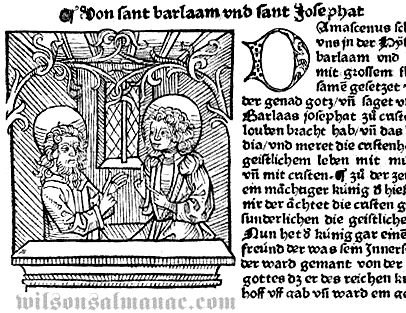


taken from: "From Genesis to the Diamond Sutra - A Western Buddhist's
Encounters with Christianity" by Sangharakshita
http://www.sangharakshita.org/bookshelf/genesis-diamond-sutra.pdf

more information:
http://en.wikipedia.org/wiki/Saint_Josaphat
http://www.gutenberg.org/dirs/etext96/bioas10.txt


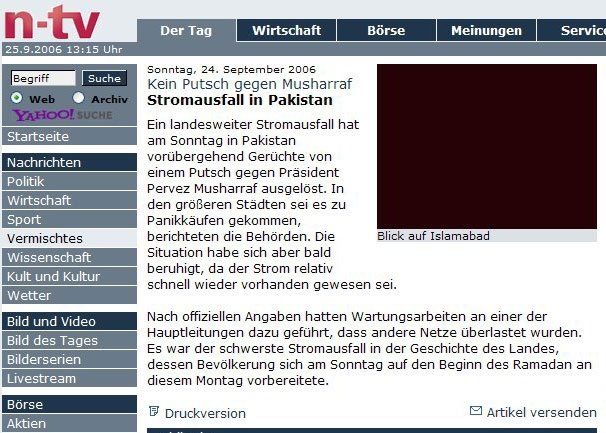
Medien-Foto des Jahres

Hier nun das Foto des Jahres....

Bin gerade auf der N-TV website auf einen Artikel getoßen der eigentlich gar nicht so besonders interessant ist - es geht um einen ziemlich heftigen Stomausfall in Pakistan. Das beigefügte Bild jedoch ist reif für einen Wurlitzer-Preis! In den Medien kursieren ja allerhand interessante Fotos - gefakte und authentische - dieses hier jedoch schlägt wirklich alles was ich in diesem Jahr bisher gesehen habe....


...übrigens: gestern ging ich nächtens spatzieren und entdeckte dabei das lange verschollen geglaubte Shambhala - hier nun exklusiv das allererste Foto:

Dakini Teachings


Seminar mit John Myrdhin Reynolds:
Dakinis: Das weibliche Prinzip im tibetischen Buddhismus

27. – 29. Oktober 2006

Freitag, 27.10.
Abendvortrag, Beginn 19.00 Uhr bis ca. 21.00 Uhr, 15 Euro
Samstag, 28.10. und Sonntag, 29.10.
Wochenendseminar, jeweils von 10.00 bis 13.00 Uhr und
von 15.00 bis 18.00 Uhr, je 40 Euro

Ort:
Tanzstudio Krippner, Obermünsterstr. 9, 93047 Regensburg
Kontakt und Anmeldung:
Tel: 0172 – 61 77 467, eMail: wolfi@grandtouring.de

Ein Bönpo-Dzogchen-Wochenende

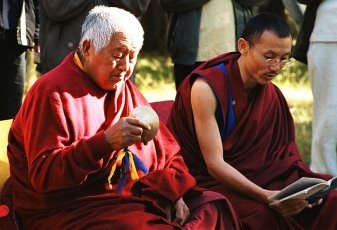
Seit Montag abend bin ich nun wieder zurück - zurück von einem der schönsten Wochenenden die ich bisher erleben durfte. Vier Tage in der Gegenwart von einem der größten und eindrücklichsten Meistern des Dzogchen. Vier Tage angefüllt mit Belehrungen über die höchsten und wundervollsten Lehren des Bön - den Lehren des Zhang Zhung Nyan Gyud. Gemeinsam mit Khenpo Tenpa Yungdrung und Geshe Samten erwies uns Yongdzin Rinpoche die außergewöhnliche Ehre seines ersten Besuches in der Schweiz, und gab uns die einmalige Gelegenheit Belehrungen mit dem Titel 'ltaba spyi gcod kyi mnyam bzhag sgom pa'i lag len' von ihm zu empfangen. Diese Belehrungen umfassen das erste Kapitel des Zhang Zhung Nyan Gyud, doch tatsächlich präsentierte uns Lopön in sehr kondensierter und komprimierter Form mehr oder weniger den gesamten Zyklus des Nyan Gyud in diesen vier Tagen, angefangen von den Ngöndro, über die besonderen vorbereitenden Übungen des Dzogchen, den inneren und äußeren Rüshen und den Semdzins, über die Traum und Nacht-Praxis, bis hin zu Trekchö, Thögal und der Dunkel-Praxis. So übertrug er den gesamten Lehr-Zyklus, mit Ausnahme der Bardo-Teachings. Lopön gab jeden Morgen mit großer Geduld und Nachsicht über einen Zeitraum von zwei bis drei Stunden die essenziellsten Unterweisungen des Nyan Gyüd, und Khenpo Yungdrung gab jeden Nachmittag ebenfalls zwei bis dreieinhalbstündige Vorträge in denen er vertiefende Belehrungen und Erläuterungen über die wichtigsten Punkte der Unterweisungen von Lopön gab.

Im Laufe der Zeit hatte ich nun bereits die Gelegenheit, von verschiedenen Lamas aus verschiedenen Traditionen Belehrungen zu empfangen, doch musste (oder durfte) ich bereits am ersten Tag dieses Seminares feststellen, dass Lopön selbst unter all den 'großen' Lamas noch eine ganz besondere Stellung einnimmt. Abgesehen von Falten und grauen Haaren ist Von seinem doch schon recht fortgeschrittenen Alter eigentlich gar nichts zu bemerken, im Gegenteil, zeitweise hatte man eher das Gefühl in der Gegenwart eines sehr sehr aufgeweckten kleinen Jungens zu sein, um nur Momente später spontan Gewissheit zu erlangen, zu den Füßen eines voll erleuchteten Buddhas zu sitzen. Selbst wenn er nur schweigend dagesessen wäre, ohne auch nur ein Wort zu lehren, wäre seine reine Anwesenheit, seine Ausstrahlung und seine enorme Präsenz ein einscheidendes und unvergessliches Erlebnis für wohl jeden von uns gewesen. Und das uns die Gnade zuteil wurde, in dieser kurzen Zeit so viele seiner kostbaren Unterweisungen zu empfangen, steigert diese Erfahrung ins schier ins Unermessliche. Lopön ist der lebende Beweis für die Wirkungsweise, die Macht und die Effizienz der Lehren der Buddhas. Jedes seiner Worte, jede seiner Handlungen, und sei es nur die kleinste Bewegung, widerspiegeln eine Kraft, die nicht in Worten beschreibbar ist, all seine Aktivitäten sind gekennzeichnet von einer unermesslichen Sanftheit, und doch gleichzeitig auch von unermesslicher Kraft und Energie. Hätte mir noch vor kurzem jemand in einem Satz gesagt, etwas sein kraftvoll und gleichzeitig sanft, so hätte ich dies als Widerspruch aufgefasst, doch nun habe ich persönlich erfahren dürfen, dass in einer solchen Beschreibung keinerlei Widerspruch zu finden ist. Die war meine erste Begegnung mit Lopön, und selbst wenn ich ihn in diesem Leben nicht mehr treffen sollte, wird diese eine Begegnung noch für sehr lange Zeit einen sehr starken Einfluß auf mich haben. In gewisser Hinsicht fühle ich mich wie ein schwer Kranker der nach langer Zeit des Leidens plötzlich auf wundersame Weise geheilt wurde - eine Erfahrung gleich einem kostbaren, unbezahlbaren Geschenk das Auswirklungen auf den ganzen Rest des Leben hat. Aber ich hoffe trotzdem sehr, Lopön noch in diesem Leben des öfteren begegnen zu können - vielleicht, wenn die karmischen Ursachen gegeben sind, schon nächstes Jahr im Pauenhof....

Aber auch Khenpo Yungdrung Rinpoche hat einen bleibenden Eindruck auf mich hinterlassen. Die Art und Weise in der er Belehrungen gibt ist ebenfalls einzigartig - so voller Frische und Witz dass er Stunden um Stunden erzählen und lehren kann ohne dass es auch nur für einen Moment langweilig wird. Selbst seine Belehrungen über die absoluten 'basics' wie Bodhichitta oder Zuflucht gestaltet er höchst interessant und immer gespickt und angereichert mit Dzogchen. So kann er in einem Satz über die Natur, Essenz und Energie sprechen, und gleichzeitig Ausführungen über Mitgefühl geben, und das ganz ohne dabei Verwirrung bei den Zuhörern zu stiften. Ich habe schon Belehrungen von anderen Lamas erhalten, die in einem Atemzug Unterweisungen über grundlegende Mahayana oder auch Hinayana teachings und über Dzogchen gaben, doch meistens verursachte ein solches Vorgehen nur mehr oder minder starke Irritationen, und manchmal schien es sogar so, als würde der jeweilige Lama das Wort Dzogchen nur deswegen von Zeit zu Zeit erwähnen, um die Zuhörer bei der Stange zu halten. Khenpo Yungdrung ist in dieser Hinsicht jedoch wirklich ganz speziell, denn er versteht es auf einzigartige Weise, Sutra, Tantra und Dzogchen Belehrungen in nur einem Vortrag so zu kombinieren, dass alle diese Lehren wie eine einzige Unterweisung erscheinen, ohne Widersprüche, Unterschiede oder Verwirrungen.

Ich könnte noch Seitenweise weiterschreiben und von diesem Wochenende weiterschwärmen, deshalb laß' ich's besser gleich hier bleiben und zeig euch lieber noch ein paar Schnappschüsse die ich gemacht habe ;-)


....der Halwiler See in Seengen....


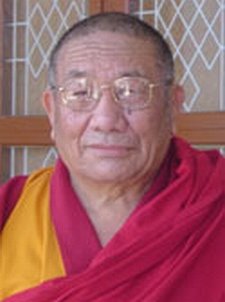
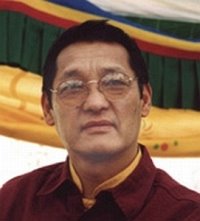
Khenpo Tenpa Yungdrung Rinpoche


Geshe Samten & Khenpo Tenpa Yungdrung


Lopön & meine Wenigkeit :-)

Arya Bhagavati Prajnaparamita Hridaya


A Chanting Guide for the Heart Sutra in Tibetan

I'm currently in the process of memorizing the Heart Sutra, and for this task I've created a small chanting-guide. Actually there is already something similar online at www.silcom.com/~eclarson/heartsutra where someone has created a nice website including the Heart Sutra in Tibetan with phonetic transcription and english translation, plus an audio version of the Sutra chanted by Thubten Gelek. Although this website is really great and I really do appreciate the work of this guy, the whole thing has some deficiencies, especially since the Lama who's chanting the Sutra is from Ladakh, therefore his pronounciation is Ladakhi. Also, he's chanting very fast and slurring some phrases etc., and that's why the whole thing isn't that efficient as a chanting guide (at least it wasn't for me).

Hence, I've created my own version of it.... On a russian server I found another recording of the Heart Sutra from a Lama named Nichang Kentrul Rinpoche. The chanting on this recording is also quite fast, but the pronounciation is much clearer, and the recording quality is better as well. I took the original version and stretched it a little, up to the point where it is slow enough, even for Tibetan beginners like myself. Due to the stretching you can hear now some strange background noises sometimes, and the voice sounds a little bit like a robot voice from time to time, but at least the whole thing is quite slow and understandable now ;-)

Another thing is that the two audio versions have some minor textual differences. I did a lot of research and compared various versions of the Heart Sutra in Tibetan and Wylie, but it seems that there are quite a few versions of this Sutra, all with some minor textual differences, so I decided to adjust my own version to the audio recording of Kentrul Rinpoche. I carefully checked the whole text, but since I'm still a beginner in the Tibetan language, it's likely that there are still some mistakes in it, so I would appreciate reports of any typos or other errors.

The word-by-word translation I've used is mainly from the other online audio version at www.silcom.com/~eclarson/heartsutra, but since I have adjusted the Tibetan text to Kentrul Rinpoche's recording, I have adjusted the word-by-word translation as well. Also, it seems that there are some small mistakes in the other translation. For example, dri med is translated as 'color not', however, dri is the equivalent of gandha, therefore the correct translation should be 'smell not' or 'odor not'.

The final translation is a mix of different translations. In fact, I just took my favourite translation of each verse from various sources like Edward Conze, George Churinoff, Lama Yeshe, the Dharma Fellowship, Nalanda, and other translations. So take the whole thing with a grain of salt ;-)


Below you can download my version of the Heart Sutra in PDF format, including Tibetan script, Wylie, a word-by-word translation, as well as the 'final' translation. The whole thing is in A4 format, but you can contact me if you need it in A5, Legal, Letter, Kai, Shiroku-ban, Kiku-ban or whatever paper size.

    ⇒ Heart Sutra Chanting Guide (PDF Format, 272 KB)


And here you can download my stretched version of Kentrul Rinpoche's audio recording in MP3 format:

    ⇒ Heart Sutra in Tibetan (128 kbps/4,53 MB)

    ⇒ The Original (un-stretched) version (320 kbps / 6,7 MB)

Tentes - Some basic teachings


Everytime I search for Geshe Ngawang Dakpa at archive.org I come across more teachings and meanwhile there's a quite huge collection of talks available there. It seems to be a very good alternative to the meanwhile very controverse teachings by the Reverend, but I'm not really sophisticated enough to judge that.... Anyway, I just came across some very interesting teachings on the 4 tenets, and I'm looking forward to study the whole course over the winter time....


Buddhist Philosophy: Tenets
by Ven. Geshe Ngawang Dakpa


Tenets - Based on the idea that the Buddha taught different things to different people in line with their capacities, Tibetan scholars systematized the numerous trends in Indian Buddhist thought and taught the four schools of Tenets (Drubtha) as a means to approach the most profound philosophical teachings via more accessible levels. The text that is the basis for study of this subject gives a brief overview of the assertions on minds, objects, selflessness and the nature of attainment within each of the schools, culminating in the tenets of the most highly esteemed school, the Madhyamikas.


Teachings on the Vaibhashika School:

Vaibhashika Teachings Part 1
Vaibhashika Teachings Part 2
Vaibhashika Teachings Part 3
Vaibhashika Teachings Part 4
Vaibhashika Teachings Part 5
Vaibhashika Teachings Part 6
Vaibhashika Teachings Part 7
Vaibhashika Teachings Part 8
Vaibhashika Teachings Part 9


Teachings on the Sautrantika School:

Sautrantika Teachings Part 1
Sautrantika Teachings Part 2
Sautrantika Teachings Part 3
Sautrantika Teachings Part 4
Sautrantika Teachings Part 5
Sautrantika Teachings Part 6
Sautrantika Teachings Part 7
Sautrantika Teachings Part 8
Sautrantika Teachings Part 9


Teachings on the Chittamatra School:

Chittamatra Teachings Part 1
Chittamatra Teachings Part 2
Chittamatra Teachings Part 3
Chittamatra Teachings Part 4
Chittamatra Teachings Part 5
Chittamatra Teachings Part 6
Chittamatra Teachings Part 7
Chittamatra Teachings Part 8
Chittamatra Teachings Part 9
Chittamatra Teachings Part 10
Chittamatra Teachings Part 11
Chittamatra Teachings Part 12


Teachings on the Svatrantrika Madhyamika:

Svatantrika Teachings Part 1
Svatantrika Teachings Part 2
Svatantrika Teachings Part 3
Svatantrika Teachings Part 4
Svatantrika Teachings Part 5
Svatantrika Teachings Part 6
Svatantrika Teachings Part 7
Svatantrika Teachings Part 8


Teachings on the Prasangika Madhyamika:

Prasangika Teachings Part 1
Prasangika Teachings Part 2
Prasangika Teachings Part 3
Prasangika Teachings Part 4
Prasangika Teachings Part 5
Prasangika Teachings Part 6
Prasangika Teachings Part 7
Prasangika Teachings Part 8
Prasangika Teachings Part 9
Prasangika Teachings Part 10
Prasangika Teachings Part 11
Prasangika Teachings Part 12

Bodhicharyavatara Study Resources


Here is a small collection with some study resources for Shantidevas 'Guide to the Bodhisattva's Way of Life':


bde gshegs chos kyi sku mnga' sras bcas dang
phyag 'os kun la'ang gus par phyag 'tshal te
bde gshegs sras kyi sdom la 'jug pa ni
lung bzhin mdor bsdus nas ni brjod par bya


"In adoration I make obeisance to the Sugatas and their sons,
and to their bodies of Dharma, and all those worthy of praise.
In brief, and in accordance with scripture,
I shall describe the undertaking of the observance of the sons of the Sugatas."

_____________________________


Original Texts:

Bodhicharyavatara in Tibetan (PDF)

Bodhicharyavatara in Tibetan (Roman transliteration)

Bodhicharyavatara in Tibetan

Bodhicharyavatara in Sanskrit


Translations online:

www.shantideva.net

Alex Berzin's Translation

Alex Berzin's Translation (PDF)

Nick Barr's Translation (PDF)

Steven Batchelor Translation (PDF)

Alan Wallace' Translation

Biona Translation


Commentaries:

Commentary by Patrul Rinpoche

Tulku Thubten Rinpoche Commentary

Commentary by Dzogchen Khenpo Choga Rinpoche

Commentary by Khenpo Kunpal

Padma Karpo Translation Committee


Audio/Video Commentaries:

His Holiness, the XIV. Dalai Lama: Teachings on A Guide to the Bodhisattva's Way of Life (Chod jug)

H.H. Dalai Lama: Shantideva’s Compendium of Precepts (Laptu) and A Guide to the Bodhisattva’s Way of Life (Chod jug)

H.H. Dalai Lama: A Guide to the Bodhisattva's Way of Life (Chod jug - Wisdom Chapter), The 37 Practices of A Bodhisattva (Lak-len so dun-ma) and Chapters 18, 22, 24 & 26 of Nagarjuna's The Fundamental Wisdom of the Middle Way (Uma Tsawa Sherab)

H.H. Dalai Lama: Oral Commentary to Chapter Eight

Dzigar Kongtrul Rinpoche: Teachings on the Bodhicharyavatara
    complete playlist

Geshe Michael Roach: Teachings on A Guide to the Bodhisattva’s Way of Life (ACI Course 10 - 12)
    complete playlist

Geshe Ngawang Dakpa: Teachings on the Bodhicharyavatara

Geshe Tsulga: The Way of the Bodhisattva
    complete playlist

Stephen Batchelor: A Guide to the Bodhisattva's Way of Life

Thubten Chodron: Commentary on Shantideva's A Guide to the Bodhisattva Way of Life

Venerable Marut: Boddhisattva's(?) Way of Life - In Depth Course


Translations & Commentaries in Print:

Translation by the Padmakara Translation Group

Guide to the Bodhisattva Way of Life: Translation by Alan Wallace

Guide to the Bodhisattva's Way of Life Translation by Stephen Batchelor

Bodhicaryavatara Translation by Crosby & Andrew Skilton

Guide to the Bodhisattva's Way of Life Translation by Thrangu Rinpoche

Santideva's Bodhicharyavatara (Sanskrit & English) Translation by Pramananda Sharma

No Time to Lose; A Timely Guide to the Way of the Bodhisattva by Pema Chodron

The Importance of Pacience: Commentaries on Shantideva's Guide to the Bodhisattva's Way of Life, Chapter Six, "Patience" by the H.H. the XIV. Dalai Lama

Meditation: Teachings on Shantideva's Guide to the Bodhisattva's Way of Life by His Holiness the Dalai Lama (DVD)

The Way of Awakening: A Commentary on Shantideva's Bodhicharyavatara by Geshe Yeshe Tobden

Practicing Wisdom The Perfection of Shantideva's Bodhisattva Way by the H.H. the XIV. Dalai Lama


A small comparison between the different translations (PDF)


_____________________________


And here is a nice little summary of the various translations of the Bodhicharyavatara, written and kindly posted on E-Sangha by my Vajra-brother Gady:


I will give my summary first, in case people know even less Tibetan than I do, or don't want to go into the details.

If you wish to read a version that is close to the exact words of the Tibetan version (for the original Sanskrit we should open another thread) the best you could do, it seems to me, is choose Stephen Batchelor's version, or perhaps the Wallaces'. Stephen's is a bit nicer design-wise, I recall from glimpsing it, and is translated from the Tibetan, whereas the Wallaces' is transalted from Sanskrit and Tibetan, Sanskrit being more dominant but when the Tibetan has major differences a footnote lists the alternate translation.

If, however, you wish to read a standalone version in English, and you are willing to sacrifice considerable (but not fatal) accuracy in order to read a work that is superb and superior in and of itself in terms of poetical beauty, flow, and, as Will has said, 'Bodhicitta Vibes', I would go for the Padmakara group's work, which is also the most beautiful, by far, in its design and cover, especially the newer exquisite reddish-gold cover. In and of itself, I also like its title best, simple and pure.


So here is a more detailed report. Perhaps I have exaggerated in the details, but I became quite fascinated with it.


Stephen Batchelor's version - A Guide to the Bodhisattva's Way of Life, Library of Tibetan Works and Archives, 1979.

This was actually a pleasant surprise. I didn't know what to expect from an old translation that was published in LTWA, when at that time the standards of translation weren't high and were (explicitly in most cases) interpretative, based on some of their other old editions I checked.

Furthermore, I didn't know what to expect form a person who, though a Tibetan tradition monk at the time of translating, later switched to Zen, then disrobed, then published a controversial book.

This version is in many ways the most simple, direct and faithful version, at least based on these three verses, from the three versions here (excluding the Wallaces') which were translated from the Tibetan alone (though consulting the Sanskrit and/or other translations from the Tibetan and Sanskrit many times).

One slight thing that bothered me just a little was that he translated 'gro ba as 'living beings' in verse #1, a bit clumsy to me. Another minor matter is that he extrapolated the 'all' those who remain in cyclic existence. The one thing that really bothered me was the fanciful 'receive Waves of joy' which is totally unrelated to the root text I have.


The Wallaces' version - A Guide to the Bodhisattva Way of Life, translated by Vesna A. Wallace and B. Alan Wallace, Snow Lion, 1997.

This version is actually primarily from Sanskrit, so I don't know how good it is for our specific purpose, though it states that it always consulted the Tibetan and when the Tibetan considerably differs brings an alternate translation of the verse in a footnote (which isn't a good idea, design-wise, imho).

A faithful and precise translation, it seems to me, based on these three verses. I found the use of 'joy and contentment' for bde dga' a little unwarranted, because I couldn't find 'contentment' for any one of these common Tibetan terms in themselves in the online dictionaries I checked (nor in the Illuminator, which I happily bought and downloaded today, which looks impressive but not comprehensive so far) and because all three other translations used 'joy' and 'happiness'. Another thing was that in the third verse they translated 'may the world attain...' which is a bit peculiar, I don't see any 'world', but rather just 'gro ba, but there might be a 'world' in the original Sanskrit, I don't know.


The Padmakara Group Version - The Way of the Bodhisattva, translated by Wulstan Fletcher, Shambhala, 1997.

I was actually a little disheartened after checking this version. It is the only version I fully read and the effect it had on me was profound. As a standalone version, it is a superb work of spiritual poetry, sublime, profound and astonishingly beautiful at one and the same time. It states in the introduction that it is not a word by word translation, but I didn't realize the extent of its stylistic rerendering, and it is a little bothering, though as a work-in-itself I still greatly prefer it to the other versions.

The many ways in which it differs from the source I have are numerous, but here are a few examples: 'the virtue I have now amassed': ammased is extrapolated, as far as I can tell (though I don't understand what rnam par does in the first verse, which seems to have been glossed over by all versions, I know its common usage, but can't make sense of it here, anyone?). Instead of 'oceans' (of joy and happiness) it has 'boundless measure', which is a bit strange considering that this is the most poetic of the translations I checked. In veres #3, in 'present joy', the 'present' is (perhaps understandably) extrapolated, and byang chub sems dpa' yi bde ba which is clearly 'bodhisattva's joy/happiness/bliss' translates as 'unsurpassed beatitude' which they may 'taste', which is perhaps good for non-Buddhists but a bit too personally- interpretatively-spelling-it-out for people who know what a Bodhisattva is, I think.

While this is the least faithful version word-wise, it is the only one who had both adjectives in the end, 'constant and unbroken'.


Alexander Berzin's version - The Berzin Archives, 2004.

This is the most interpretative and didactic of the versions, even after I have excluded (for reasons of space) the further interpretative additions in parentheses. At times it is a bit bizzare.

In verse #1 he adds 'my constructive act' (of having composed), which as far as I can tell is unwarranted and also somewhat his own idea. If by this he means to translate rnam par it is quite strange. Similarly, in verse #2 he gives 'Through the forces of my positive acts' for bsod nams kyis. As far as I can tell bsod nams is usually rendered as 'merit' or 'virtue', perhaps 'positive' is appropriate, but it can also mean mental 'actions' which isn't implied by Berzin's choice of English. This is a big difference, but of course I know next to nothing about Tibetan and will humbly stand corrected. 'forces' is also unwarranted in this case, though it could easily have been used had the common dbang appeared here, but it doesn't.

Furthermore, he also uses 'unsurpassed bliss' (though in parentheses he does add "bodhisattva's"), which is too far away from the literal to my mind, like Padmakara's.

One thing I did like was that he was the only one who used 'wandering beings' for 'gro ba, which is both more literal and conveys the flavor of this common Tibetan term. I myself might have chosen 'wanderers' by itself, I think it is one of those rare cases where the English word is in this case perhaps even better in a way, in what it gives rise to in the mind of the reader, than the original term it translates.


http://www.lioncity.net/buddhism/index.php?showtopic=25284#

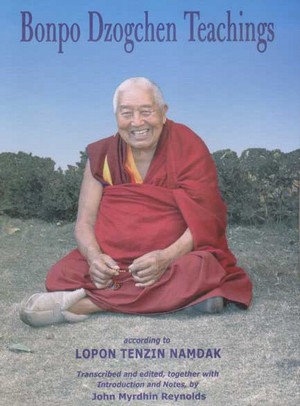
Bonpo Dzogchen Teachings

A new book by Lopön Tenzin Namdak Rinpoche is now available:


Bonpo Dzogchen Teachings

During 1991, the Bonpo Dzogchen master, Lopon Tenzin Namdak, visited the West twice, coming first to Europe and later to America, where he taught a number of meditation retreats and gave a series of public talks on Bon and Dzogchen. In March and April, Lopon Rinpoche taught a meditation retreat focusing on the practice of Dzogchen at Bischofshofen, south of Salzburg in the Austrian Alps, and several weeks later he gave a series of talks on Dzogchen at the Drigung Kagyu Centre in Vienna. After that he went to Italy where he taught two retreats in Rome, and also briefly visited Merigar in Tuscany, the retreat center of Namkhai Norbu Rinpoche. Coming to England next, the Lopon taught a ten-day Dzogchen retreat in Devon in the west of England, at a locale near Totnes, and after that he gave several talks in London. Proceeding later to Amsterdam, he taught a five-day retreat on Dzogchen in the city at the beginning of June. With the exception of the Italian visit, I was present on all of these occasions and served as a facilitator and sometime translator for the teachings.

Then in October, Lopon Rinpoche visited New York city at the invitation of H.H. the Dalai Lama and Tibet House, to participate in the Kalachakra Initiation and in other activities connected with the Year of Tibet. In particular, the Lopon was the first speaker in the afternoon series called "Nature of the Mind Teachings." During the Devon retreat, the Lopon had prepared a brief paper on the Bonpo teachings for presentation in this series in New York. I translated this into English as "The Condensed Meaning of an Explanation of the Teachings of Yungdrung Bon" and this has been published elsewhere. During his time in New York city, the Lopon gave three further talks, at which I was again the facilitator as I had been in Europe. Towards the end of the month, at the teinvitation of the Dzogchen Community of Conway, known as Tsegyalar, the Lopon gave a weekend seminar at Amherst College in western Massachusetts. In November, I met up with the Lopon in San Francisco where, again at the invitation of the Dzogchen Community, he gave a two-day seminar on Guru Yoga practice. After that he went to Coos Bay, Oregon, where for eight days he held a retreat on the Dzogchen teachings.

On these occasions also I served as facilitator and translator and made detailed notes on the teachings. These notes again served as the basis of the transcripts found herein of the Lopon's teachings in America. Although the Lopon spoke in English, on many occasions he asked me to translate technical terms and help clarify various other technical points. All of this I recorded in my notes. In order to further clarify matters, he requested that after each portion of the teaching I repeat from my notes what he had said. So the transcripts found here result from our collaboration together. Nevertheless, I alone must take responsibility for any errors that might be found. I have done some editing of the transcripts, adding any additional clarifications required as well as any sentences needed to link the various paragraphs or topics. But generally, I have left the language in the style of the Lopon's oral presentation and have not rendered the text into a literary presentation since the present collection of teachings is not envisioned as a commercial publication, but as an aid for practitioners of Dzogchen.

I have included only transcripts directly related to the Lopon's teachings on Dzogchen, and to where the views of Sutra and Tantra are contrasted with that of Dzogchen. The Lopon's teachings on Guru Yoga, the Rite of the Guardians, specific Tantric teachings such as the practice of Zhang-zhung Men, and so on, as well as the Dzogchen teachings from specific texts of the Zhang-zhung Nyan-gyud, are found elsewhere in the publications of the Bonpo Translation Project.

I began working on the translation of Bonpo Dzogchen texts first with Geshe Tenzin Wangyal in Italy some years ago, and continued doing this with Lopon Tenzin Namdak on his three visits to the West. As a consequence of this work, I organized the Bonpo Translation Project in order to make translations of Bonpo texts and prepare transcripts and monographs on the Bonpo tradition available for interested students and practitioners in the West.

Before the arrival of these two learned Bonpo Lamas in the West, my interest in the Bon tradition was stimulated by Namkhai Norbu Rinpoche, head of the Dzogchen Community. Rinpoche, although not a Bonpo Lama himself, was for many years interested in the Bonpo tradition because he was researching the historical roots of the pre-Buddhist Tibetan culture known as Bon. He was also very interested in discovering the historical sources of Dzogchen teachings, for which there exist two authentic lineages from at least the eighth century CE, one found among the Nyingmapas and the other found among the Bonpos. More than any other Tibetan teacher, Namkhai Norbu Rinpoche has played a key role in transmitting Dzogchen teachings to the West, and for this he has the profound gratitude of all of us.

For their help and assistance in various ways during the retreats with Lopon Rinpoche and also later while compiling and editing these transcripts, I wish to thank Gerrit Huber, Waltraud Benzing, Dagmar Kratochwill, Dr. Andrea Loseries-Leick, Armin Akermann, Ken Rivad, Tim Walker, Lee Bray, Florens van Canstein, Michael Katz, Des Berry, Dennis Waterman, Bob Kragen, Michael Taylor, Anthony Curtis, and last, bu~ not least, Khenpo Nyima Wangyal and Geshe Tenzin Wangyal. It is also my hope here as translator and editor that this small collection of Lopon Tenzin Namdak's teachings on Dzogchen according to the Bonpo tradition, its view and its practice, will prove of use and benefit to Western students and practitioners of Dzogchen.


Preface to the New Edition

Even though these teachings on Dzogchen were given by Lopon Tenzin Namdak Rinpoche some years ago in 1991, and have circulated privately as transcripts, they remained in need of some further editing regarding repetitions and annotations. This has been provided here, as well as a new introduction to Bon in general, and some further material on the education given to young monks and nuns at Lopon Rinpoche's monastery in Kathmandu, Triten Norbutse (Khri-brten nor-bu'i rtse). This further material is found in the appendix. The monastery is primarily an educational institution for monks and nuns, aimed at preserving and perpetuating the ancient culture of Bon, rather than a residential monastery. After finishing their education here, the former students will go elsewhere and serve as teachers or enter lay life. Students are drawn from the Bonpo areas of Nepal, such as Dolpo and Mustang, as well as from Tibet itself, where a traditional Bonpo education is becoming progressively more difficult to obtain.

The educational program at Triten Norbutse includes the thirteen-year course in Geshe studies at the Dialectics School or Lama College (bshad-grwa), at present under the direction of the chief teacher of the Dialectics School (mtshan-nyid bshad-grwa dpon-slob), Lopon Tsangpa Tenzin. The focus is on the philosophical studies (mtshan-nyid) found in the Bonpo tradition, and on cultivating skills in correct thinking and the art of debate (rtsodpa). In addition, a number of traditional secular sciences (riggnas) are studied and mastered. Upon completion of the course and passing several examinations, the student is awarded a Geshe degree (dge-bshes), the equivalent of a Western doctorate. Independent of this program in Geshe studies, there is also a Meditation School (sgrwb-grwa) at the monastery which has a four-year program for the study and practice of the four major systems of Dzogchen found in the Bonpo tradition. Whereas in the Dialectics School, the emphasis is on academic study and learning the skills of debate, here the emphasis is on the actual meditation practices of Dzogchen in a semi-retreat situation. This school is at present under the direction of its Abbot (sgrub-grwa mkhan-po), Kenpo Tsultim Tenzin. During these courses of study and practice, the students are housed and fully supported by the monastery. Frequently young monks and nuns come as refugees from Tibet seeking a Bonpo education and possess no funds of their own at all.

With Lopon Rinpoche now in retirement at the age of 80, the monastery is under the able direction of its present Abbot, Khenpo Tenpa Yungdrung. However, Lopon Rinpoche continues to teach on occasion at the monastery, in sessions open to both monks and lay people, and also to Westerners at his new meditation center in France, Shenten Dargye Ling, near Saumur in the Loire region, south-west of Paris. Moreover, Lopon Rinpoche's collected works (gsung `bum) in thirteen volumes were published last year by the monastery. A number of Geshes at the monastery, with the help of modern computer technology provided by Japanese friends, have been digitalizing the basic Bonpo texts which are studied at the monastery, including those of Dzogchen. The texts are then published in India and Nepal for the use of students.

Now that Bon is becoming increasingly recognized in the West as an important spiritual tradition in its own right, and as an original component of the Tibetan culture and civilization which continues and even thrives today both in Tibet and in exile, it was felt that these teachings of Lopon Rinpoche on Dzogchen should be republished for a wider reading audience. My thanks, as the editor of these teachings, go to Vajra Publishing of Kathmandu for undertaking this project, to Elisabeth Egonviebre for providing the photographs included here, and to Dr. Christine Daniels for her editorial and other help while completing this project. I would especially like to thank Khenpo Tenpa Yungdrung for supplying additional information on the expanded educational program at Triten Norbutse. It is my prayer that these rare explanations of Lopon Tenzin Namdak Yongdzin Rinpoche, being exceptionally lucid and clear, will help to clarify the relationship between Dzogchen and Madhyamaka, Chittamatra, Tantra and Mahamudra, for interested Western students.

(John Myrdhin Reynolds)

www.wisdom-books.com

Seminare & Retreats im Herbst

Herbst-Ausblick

....hier ein kleiner Ausblick auf einige der Seminare und Retreats im
deutschsprachigen Raum:


5. – 12. Oktober 2006
Ermächtigungszyklus des ‘Künsang Gongdü’
mit S.E. Gangteng Tulku Rinpoche
Hamburg, Deutschland

www.yeshekhorlo.de


6. - 9. Oktober 2006
Dzogchen Belehrungen aus der Bön Tradition
von Shang Shung Nyan Gyud

mit
Yongdzin Rinpoche Tenzin Namdak
und
Khenpo Tenpa Yungdrung Rinpoche
in der Schweiz

www.garudaswitzerland.org


09. – 15. Oktober 2006
Chö-Belehrungen und
Einweihung in Prajnaparamita und Karma Pakshi

mit dem Ehrw. Khenchen Thrangu Rinpoche
Kamalashila Institut, Germany

www.kamalashila.de


13. - 15. Oktober 2006
Die kombinierte Praxis von Mahamudra und Maha-Ati &
Padmasambhava-Einweihung

mit dem Ehrw. Tenga Rinpoche
Gutenstein/NÖ

www.maitreya.at


20. - 22. Oktober 2006
Bonpo Dzogchen Teachings from the Zhang-zhung Nyan-gyud
mit John Myrdhin Reynolds

www.vajranatha.com


21. - 29. Oktober 2006
Einweihung in die
Ungewöhnliche Weiße Tara & die 21 Taras

mit Jetsun Chimey Ludig
Pauenhof, Germany

www.pauenhof.de


7. - 9. November 2006
Gyetrul Jigme Rinpoche
Schweiz

www.padmaling.ch


10. - 12. November 2006
Tantric Transformations: The Practice of Kyerim
and Dzogrim in the Higher Tantras

mit John Myrdhin Reynolds
Kamalashila, Eifel, Central Germany

www.kamalashila.de


16. - 19. November 2006
Kalachakra Teachings & Initiation
with
His Holiness
Sakya Trizin Rinpoche

Pauenhof, Germany

www.kalachakra2006.de


17. - 19. November 2006
Einweihung in die Grüne Tara &
Belehrungen zur Tsa Lung Tigle Praxis

mit Chenga Rinpoche
in München, Deutschland

www.garchen.de


06. Dezember 2006
Besuch S.H. Pema Norbu Rinpoche
im neuen Palyul Zentrum in Züsch, Deutschland
(noch keine genaueren Details bekannt....)

Edited (on Oct. 13): Visit Canceled!

www.palyul.de


9. - 12. Dezember 2006
Ranyak Dza Patrul Rinpoche
Schweiz, Zürich

www.patrulrinpoche.org