The Essence of Thönmi’s Masterpiece 'The Thirty Verses'
by Yangchen Drubpe Dorje (1809-1887)
Namo guru mañjughoshaya!
To Mañjughosha, who is inseparable from the supreme teacher,
I respectfully bow down.
I shall now explain, in a brief summary, the essence
Of Thönmi’s excellent work, The Thirty Verses.
The function of the vowels is to make clear,
There are four: i, u, e and o.
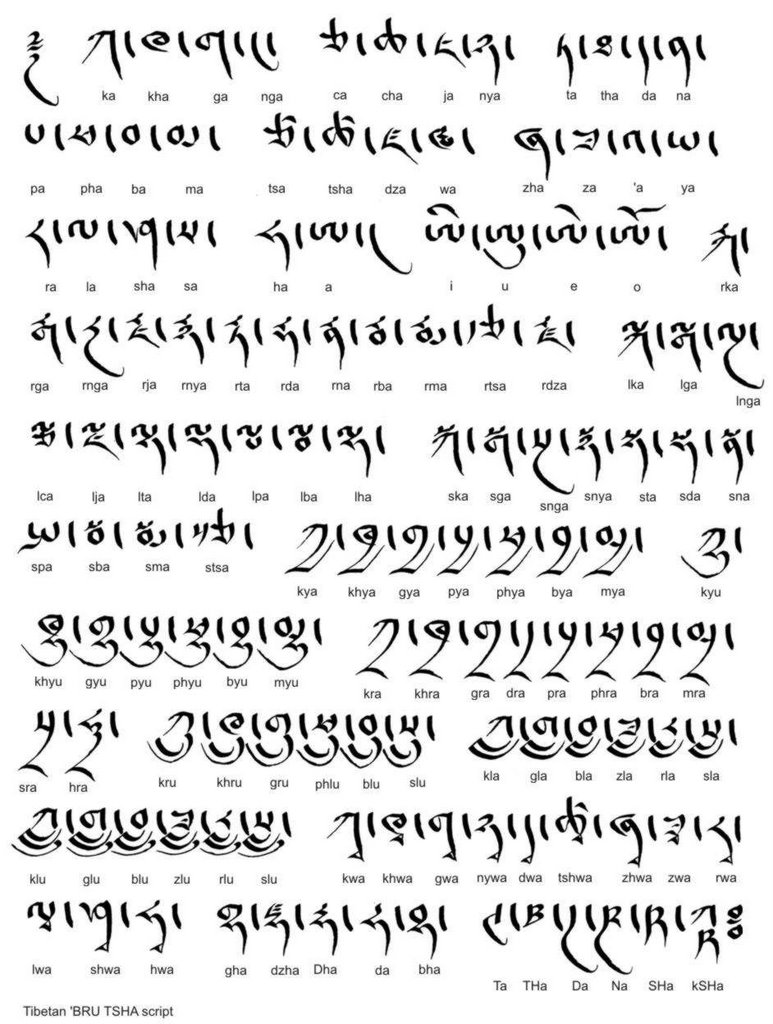
The consonants, ka and so on, are thirty in number.
ga, nga, da, na, ba, ma, ‘a,
And ra, la and sa are the ten suffixes.
da and sa are the two post-suffixes.
The three [suffixes] na, ra and la take [post-suffix] da,
And [post-suffix] sa is added after ga, ba and ma.
ga, da, ba, ma and ‘a are the prefixes.
Go, ngo, do, no, bo, mo, ‘o,
And ro, lo, so, to are the concluding particles,
Also called the ‘terminative’ or ‘paired concluding.’
to is used with a da-drak and ‘o where there is no suffix.
The others match the final letters of the preceding syllable.
Su, ru, ra, du, na, la and tu
Are the seven la-equivalent particles,
They are used with the second, fourth and seventh cases,
And with ‘identity’[1] and the ‘temporal.’[2]
su follows a sa, tu is used after ga, ba and da-drak,
du is used after nga, da, na, ma, ra and la,
Syllables ending in ‘a or without a suffix take ra and ru.
The five of gi, kyi, gyi, ‘i and yi
Are the connective particles of the sixth case.
The same five with the ending sa
Are the third case, the agentive.
They are applied as follows: na, ma, ra and la take gyi;
da, ba and sa take kyi; ga and nga take gi;
Syllables ending in ‘a or without a suffix take ‘i and yi.
kyang, yang and ‘ang are the three ornamental and inclusive particles.
kyang is used after ga, da, ba, sa and da-drak,
yang after nga, na, ma, ra and la,
‘ang and yang are used after syllables ending in ‘a or without a suffix.
te, de and ste are the three continuative particles.
te is used after na, ra, la, sa and da-drak,
de is used after da, and after ga, nga, ba, ma, ‘a
And syllables without a suffix ste is used.
gam, ngam, dam, nam, bam, ‘am,
ram, lam, sam and tam divide and include.
The rules of application are like those of the concluding particle.
The forms ra and ru, ‘i and yi or ‘ang and yang
Differ in respect to how they can fill or not fill a line of verse.
The same principle determines whether or not
There is a dot before ‘o, ‘u and ‘am.
nas and las are used for the ablative, and for isolation and inclusion.
For the actual ablative, either form may be used.
For isolating similar things nas is used and for dissimilar las.
Whereas for inclusion only nas may be used.
kye and kvaye are vocative particles.
They usually come before the noun.
ni is the particle of highlighting and emphasis.
dang has five uses: to include, to divide and to indicate a reason,
A temporal relation or a command.
The pronoun particle de, which is used before a noun,
Refers either to a term just used,
Or another not stated [but implied].
ci, ji, su and gang are indefinite particles.
ci is used before zhig, ste, slad, ‘dra and phyir.
ji is used before snyed, srid, ltar, bzhin and skad.
su applies to people only, but gang is universal.
pa, ba and ma, with or without an o vowel,
Are the nominalizing particles. After ga, da, na,
ba, ma, sa and da-drak, the particle pa is used.
After nga, ra, la and where there is no suffix,
The nominalizing particle that is used is ba,
But it is good to use pa when there is an even number of syllables.
It is the same in most cases for words ending in pa or ba.
The use of ma is irregular and determined by context.
ma, mi, min and med are the particles of negation.
ma and mi come before a word, min and med at the end.
ma can also be used as a clarifier in between [two words].[3]
The particles zhing and so on are used after syllables ending in nga, na, ma,
‘a, ra, la and those without any suffix.
They are zhing, zhes, zhe’o, zhe na and zhig.
After syllables ending in ga, da, ba and a da-drak,
cing, ces, ce ‘o, ce na and cig are used.
After a final sa, zhes is the special exception,[4]
But shing, shig, she ‘o and she na are all used.
However, it is important not to confuse these
With actual words like kha cig, lhan cig and so on.
A bare basic letter with a prefix will need the suffix ‘a,
But not [a basic letter] with a vowel sign, or a head or subjoined letter.
To separate words in longer passages of prose,
To divide medium-length passages and conclude short ones,
And following a ga in a line of verse, use a single shad.
Use a double shad in prose following a terminative particle,
Or at the end of a line of verse.
A quadruple shad is required at the end of a long section of text,
Or at the conclusion of a chapter.
Take special care not to do such things as writing a dot
Between a final letter and a shad, unless the letter is a nga.
This wish-fulfilling tree of fine explanation,
Unobscured by the leaves of excessive words,
And laden with the plentiful fruit of meaning,
Was composed by Yangchen Drubpé Dorje.
____________________________
[1] A sub-category of the second case.
[2] A sub-category of the seventh case.
[3] In some tri-syllabic expressions ma is found in between two syllables, negating them both: rta ma bong = Neither horse nor donkey; rta ma lug = Neither goat nor sheep. These expressions are used by way of analogy for a mixture that is neither quite one thing nor another.
[4] In other words, shes is not used so as to avoid confusion with the verb ‘to know’, and zhes is used instead.
Download the Tibetan text (in PDF format)
taken from www.lotsawahouse.org